
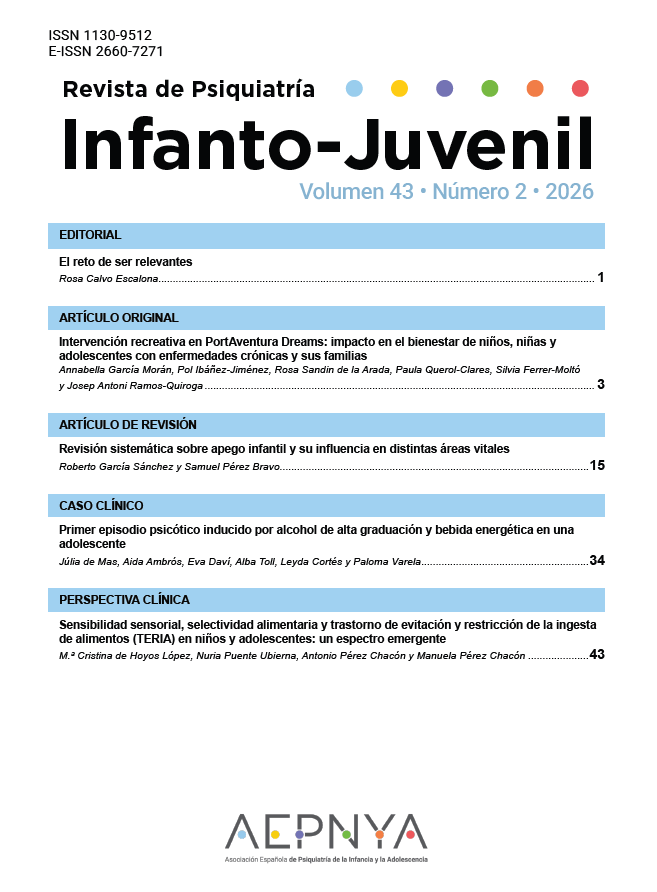
Recreational intervention at PortAventura Dreams: impact on the well-being of children and adolescents with chronic illnesses and their families
Downloads
Published
How to Cite
Issue
Section
License
Copyright (c) 2026 Revista de Psiquiatría Infanto-Juvenil

This work is licensed under a Creative Commons Attribution-NonCommercial-NoDerivatives 4.0 International License.




DOI:
https://doi.org/10.31766/revpsij.v43n2a2Keywords:
chronic diseases, autism spectrum disorder, recreational intervention, anxiety, paediatric quality of lifeAbstract
Introduction: Children and adolescents with severe chronic illnesses or autism spectrum disorder (ASD) and their families often experience a high emotional burden and elevated levels of anxiety. Although
recreational interventions may provide psychosocial benefits, evidence regarding their effectiveness is scarce. Objectives: This study evaluated the impact of a sixday
recreational intervention at PortAventura Dreams (Tarragona, Spain) on caregiver burden, anxiety, and pediatric quality of life in 105 pediatric patients and their caregivers. Methods: The design was pretest–posttest, with no structured therapeutic programming or healthcare professionals, and assessments were conducted at baseline, one week, and four weeks after the intervention, using the Caregiver Burden Scale (Zarit), the State-Trait Anxiety Inventory (STAI/STAIC), and the Pediatric Quality of Life Questionnaire (PedsQL). Results: Statistical analyses showed significant reductions in caregiver burden and anxiety levels in both children/adolescents and caregivers (p < 0.001) across the three assessment points. Pediatric quality of life showed slight but statistically significant improvement (p < 0.001). Conclusions: These results suggest that a family recreational intervention, even
without professional support, can reduce emotional burden and anxiety in families with children with severe chronic illnesses or ASD, although the impact on pediatric quality of life requires further research.
Downloads
References
REFERENCIAS
Saßmann H, Kim-Dorner SJ, Berndt V, Biester T, Dehn-Hindenberg A, Heidtmann B, et al. Understanding Daily, Emotional, and Physical Burdens and Needs of Parents Caring for Children with Type 1 Diabetes. J Diabetes Res. 2022: 1-11.https://onlinelibrary.wiley.com/doi/10.1155/2022/9604115
Stathopoulou A, Fragkiadakis GF. Assessment of psychological distress and quality of life of family caregivers caring for patients with chronic diseases at home. AIMS Public Health. 2023; 10(2): 456-68. https://www.aimspress.com/article/doi/10.3934/publichealth.2023032
Cousino MK, Hazen RA. Parenting Stress AmongCaregivers of Children With Chronic Illness: A Systematic Review. J Pediatr Psychol. 2013; 38(8): 809-28. https://doi.org/10.1093/jpepsy/jst049
Tedla JS, Asiri F, Reddy RS, Sangadala DR, Gular K, Kakaraparthi VN. Assessing the quality of life in children with autism spectrum disorder: a cross-sectional study of contributing factors. Front Psychiatry. 2024; 15: 1-10. https://doi.org/10.3389/fpsyt.2024.1507856
Deniz E, Francis G, Torgerson C, Toseeb U. Parent-Mediated Play-Based Interventions to Improve Social Communication and Language Skills of Preschool Autistic Children: A Systematic Review and Meta-analysis. Rev J Autism Dev Disord. 2024. https://doi.org/10.1007/s40489-024-00463-0
Chiang FM, Yu YT, Liu MH, Kuo CC, Hsieh CL, Chen KL. A social-competence group intervention featuring didactic teaching and practice in play contexts for preschool children with autism spectrum disorders. Res Autism Spectr Disord. 2024;110. https://doi.org/10.1016/j.rasd.2023.102286
Thomas S, White V, Ryan N, Byrne L. Effectiveness of play therapy in enhancing psychosocial
outcomes in children with chronic illness: A systematic review. J Pediatr Nurs. 2022; 63: e72-81. https://doi.org/10.1016/j.pedn.2021.10.009
Tan J, Yin H, Meng T, Guo X. Effects of sandplay therapy in reducing emotional and behavioural problems in school-age children with chronic diseases: A randomized controlled trial. Nurs Open. 2021;
(6): 3099-110. https://doi.org/10.1002/nop2.1022
Gao J, Song W, Huang D, Zhang A, Ke X. The effect of game-based interventions on children and adolescents with autism spectrum disorder: A systematic review and meta-analysis. Front Pediatr. 2025; 13:1-19 https://doi.org/10.3389/fped.2025.1498563
Baharian N, Raji P, Alizadeh Zarei M, Baghestani AR. Effectiveness of a Sensory Play Activity Program with Parent Engagement for Children with Autism Spectrum Disorder: A Randomized Control Trial. Iran J Psychiatry Behav Sci. 2023;17(4): 1-11. https://doi.org/10.5812/ijpbs-136750




 © 2021 AEPNyA Todos los derechos reservados